
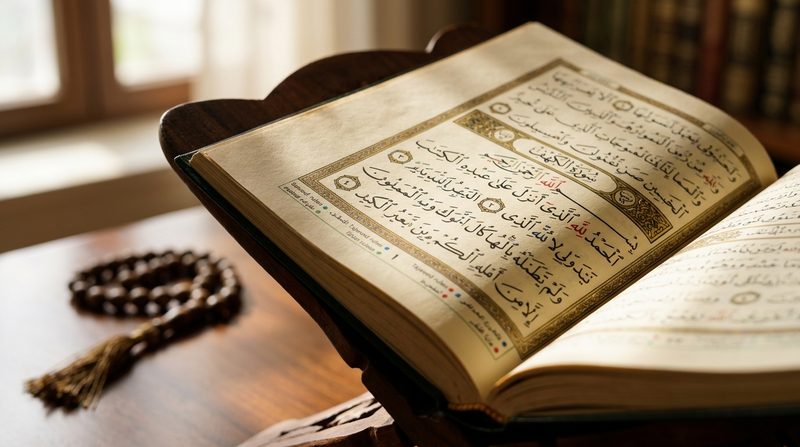
The science of Tajweed (تجويد) literally means giving every Arabic letter its rightful pronunciation, articulation point (Makhraj), and intrinsic attributes (Sifat). In Quranic recitation, precision is essential because a slight shift in sound can completely change the grammatical meaning of the holy verses.
1. Confusing Similar-Sounding Letters (Lahn Jali)
Non-native speakers frequently substitute heavier Arabic throat letters with soft English or Urdu equivalents:
- ح (Ḥaa) vs هـ (Haa): Pronouncing Al-Rahman with a soft chest 'H' alters the sacred divine attribute. ح must originate from the middle of the throat with sharp breath flow.
- ع (Ayn) vs أ (Alif/Hamzah): Merging the deep pharyngeal contraction of ع into a simple open 'A' vowel.
- ط (Taa) vs ت (Taa) & ص (Saad) vs س (Seen): Failing to elevate the back of the tongue (Isti'la), turning heavy letters into thin letters.
2. Rushing Through Madd (Elongation Vowels)
Another frequent mistake is reciting natural Madd (Madd Asli - 2 Harakats) too quickly, or failing to extend required Madd (Madd Lazim - 6 Harakats). When reciters speed up without an Ijaazah tutor checking their cadence, letters like Alif, Waw, and Yaa disappear into unpronounced short vowels.
3. Skipping or Shortening Nasalization (Ghunnah)
The rules of Noon Sakinah and Tanween (specifically Idgham with Ghunnah and Ikhfa) require holding a melodic nasal sound in the nasal cavity (Khayshoom) for a duration of exactly 2 counts. Beginners frequently treat Noon like an ordinary consonant, stripping the recitation of its rhythm.
Master Your Recitation with Ijaazah Tutors
Get real-time feedback on your Makharij in one-on-one sessions.
Enroll in 1-on-1 Tajweed Course